I think the quality which needs reflecting on is not that in any given year they're always wrong, but that for all years they have been specifically wrong on the lowside.
This can't be an averaging error where they refactor the model from past experience alone because it would either be asymptomatic or variant about the true rate. (I.e. both higher and lower, not just always lower. For the variance to always be lower it's either got to approach the value and so reflect feedback into the model, or its just.. wrong)
Unless they're getting less wrong each year, this is basically doubling down on a faulty methodology. No other discipline would accept this multi year, would they?
They're using linear extrapolation. and it's clearly an exponential curve after the fact. the problem is when does it hit saturation and flatten out like an s curve.
It's not like we've never seen a logistic supply issue before. If they just said linear as a lowside and did a high side based on saturation at some chosen level we'd have a bracketing. But instead they tick a pessimal box, and then pundits use it and planners use it as gospel for setting finance and risk rates. It's insane planning..
I'm not familiar enough with the machinations of these groups, but could this be explained by loss aversion?
Like I've always heard that meteorologists predict rain more often than their models would actually imply -> because people get mad if they make plans and they get rained out.
Is anyone "mad" if PV beats estimates or conversely is someone at the IEA going to lose their job if they say: "this is the year that solar is blowing up" and someone invests and it's finally the year it takes a break?
> "this is the year that solar is blowing up" and someone invests and it's finally the year it takes a break?
Do you think analysts take more risk hyping solar (b/c investors in renewable energy could lose some $ if solar stalls) or by playing down solar (b/c investors in fossil fuels could lose $$$ if solar keeps growing)?
I guess fear originates from the side where most capital is at risk. Hint: not solar.
Reminds me of the old IBM quote about the market for computers.
It just sounds like a combination of old and entrenched thinking. For the longest time nothing could shake fossil fuels and anyone who believed otherwise was proven wrong. People in the fossil fuel community could succeed while dismissing renewables. But the facts no longer support those old positions, and entrenched organizations will be slow to pick up on it.
I’ve never heard of this organization but I hope they’re not driving policy changes anywhere, though they sound like the kind of org that would...
It just sounds like a combination of old and entrenched thinking.
My experience of economics modelling (admittedly very limited) is that it can't help but be skewed towards the status quo. The only solid figures they can use are historical, which will only act as an anchor to the predictions of the potential future.
Additionally, economic modelling is often used as a risk analysis tool, and 'knowns' (with solid historical numbers and patterns) are always less risky than 'unknowns' with limited information.
'New' always faces an uphill battle on many fronts.
If it wasn't for pollution, it would be an exciting time to live in. Expect a new influx of Science Fiction books. The genre was born in XIX, the age of crazy progress. I think our time is a similar breakthrough, thanks to personal computers and the Internet.
Science Fiction is older than the 1900s. Just check on Jules Verne. The name "science fiction" is from the 1850's, arguably before "XIX". First almost SF books appeared in 1810 (Julius von Voß)
I'm going through a 4-book science fiction anthology which starts with Gilgamesh, Utopia, City of the Sun and so on. You really don't need to tell me that. My point was that SF surges in times when science achieves major wins. One surge was in XIX, another in 50's because of first men in space and on the Moon, as well as nuclear holocaust scare.
They didn't say science fiction is form the 1900s aka, the twentieth century. "XIX" is "19" in roman numerals, as in, nineteenth century. 1800-1899 was the nineteenth century.
...which makes sense because true exponentials cannot exist in physical reality; what looks exponential is the beginning of a sigmoid or bell curve. So the question becomes what the limiting factors are and when they will kick in, thus ending the exponential growth.
Are the IEA's terrible predictions used when modeling future CO2 emissions for climate studies? Will the growth of solar put a dent in all those really pessimistic climate models out there?
I haven't seen many market studies but those that I saw were... not very predictive beyond rolling dice and generic drawing exponential curves.
I think we might have reached the point where push comes to shove and solar is making its breaktrough. You can't really predict when that will happen. The best we can do is "when problem X is solved" or "price point Y is reached" then it will go off and "once it does it will reach XX% market share in a short time." Afterwards it is easy to pinpoint the exact time where it went off. But beforehand. Hard. Probably impossible. Many technologies die without gaining wide adoption.
The question I'm asking is not how fast solar will reach some percentage but where will it level off? 20%, 50%, 80% of total electricity generation? Will it replace fossil fuel or will it add to that? The total primary energy market is huge compared to just electricity. Will solar replace much of the primary energy consumption, too?
The point I like to make is a lot of countries don't have any vested interest in fossil fuels for power generation/transportation. In fact needing to pay for oil and gas requires them to exchange local resources for USD.
One can totally see a rush for the exits as the cost of solar continues to fall. While less developed countries will skip oil and gas for newer development.
That is going to depend on what energy-storage technology its paired with to handle when demand outstrips supply. Currently, that role is played by natural gas turbines, which are quick to turn on.
No, storage is near irrelevant already. Math for one square meter of solar paneling: that's 186 W of solar cells[1], about $192 installed[2], including land cost, taxes, etc etc etc. A residential system will cost about 3x as much. Over most of the US, that panel will generate an average of 1 kWh per day (5.5 kWh insolation times 18.6% efficiency). To a rough approximation you'll need to store about 30% of that power overnight- 300 Wh. Lets call that $120/kWh for the batteries- that's a reasonable large-scale current cost. Say it lasts 5000 cycles, same as the Tesla powerwall- 13.7 years. In reality that could last way, way longer at a slightly higher capacity, but say you just replace it until the panels run out. That's $192 for the panels and $108 for the batteries, warrantied for at least 41 years. That gives you a cost of 2.0 cents per kWh. Even if you quadruple the cost of batteries, solar is still stupid cheap.
I would just like to make the point that this is actually the greatest pain point now. Solar is not getting financed exactly because it is stupid cheap and getting cheaper.
Think about it: will you be investing in something that's already stupid cheap (with bad margins, and heavy international government competition making it cheaper), and getting cheaper ?
That would be a VERY bad investment decision.
So what's happening is "the datacenter investment". Solar power plants are mainly being built and financed by the customers of their electricity, who use it to disconnect from the grid (to some extent). Nobody's investing in it, because it's not necessary.
See, this is where I get tripped up. Because I'd think that it would definitely be the time to invest. That you'd want to cut a deal to deliver X amount of solar capacity / year for the next 20 years at what strikes today's buyer as a cheap price. Then you've locked in the payback for the next two decades as the cost to product plummets and your margins expand every year.
There was some talk about how this was the thinking behind the recent "below cost" bids happening in the middle east.
This is exactly "the datacenter investment". But the only people who can make it are established companies with predictable long-term power needs. You cannot really invest in it.
Investing in solar companies however (e.g. SUNE, SCTY, ...) went badly (of course SCTY "turned out well" thanks to Elon Musk putting up 2 billion of not-quite-his-own money to saving it, presumably mostly to protect his reputation. This is ironically another reason not to invest, as the difference between a large loss and a large gain was created only by a large external force (sort-of government even, if you consider just how much government money TSLA gets))
So an investment in SCTY was pretty much a simple bet: "do you believe the government will bail out SCTY ?". The answer was yes, in a roundabout way. In the case of SUNE, the answer was no.
Solar could provide around half of our electricity without grid storage. Assuming you turn everything else off in the day time and shift demand a lit east / west to better fit the demand curve. Considering it's currently the cheapest source that seems like a reasonable ballpark prediction IMO.
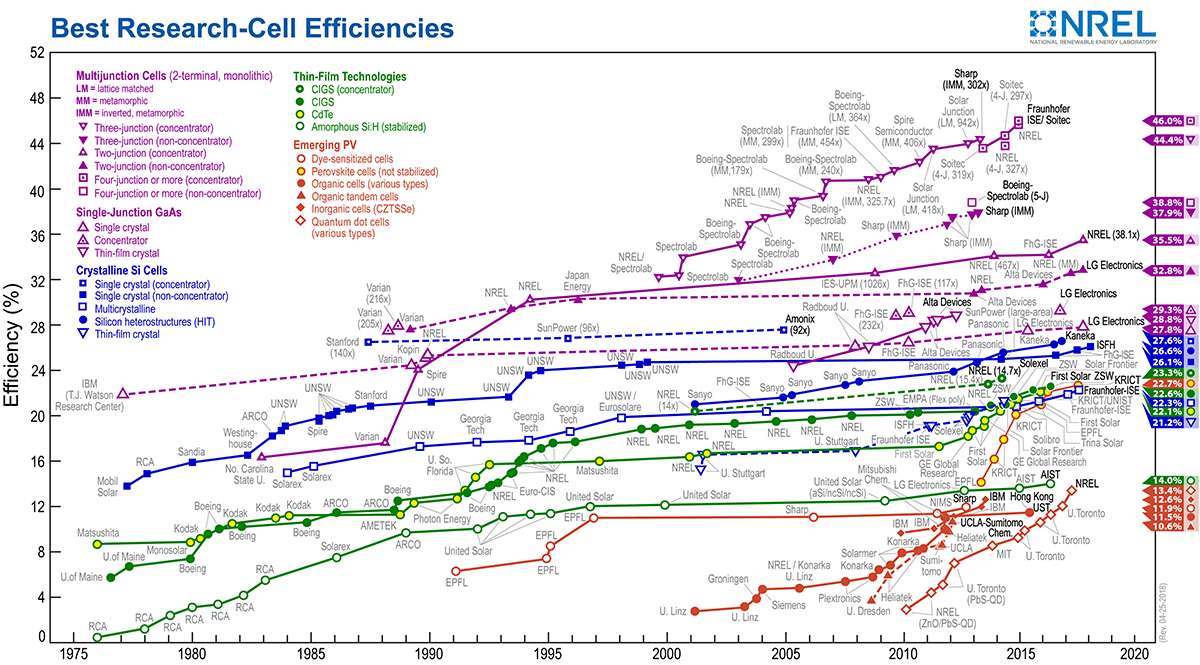
There is always the new hotness. The researchers and research money needs to go somewhere. Until it reaches silicon levels of efficiency and durability it won't become a serious contender. Silicon has reached the point where it is 'good enough' to go further and further. Usually 'good enough' wins versus 'perfect but not quite ready'. We may see with great interest where the perovskites start to level out in efficiency. If they really come close to silicon and stability is solved the market might shift very quickly.
That has to be the most detailed (yet still legible) and informative graph I have seen in a very long time. Thanks. I had never heard of the National Renewable Energy Laboratory https://www.nrel.gov/ before.


This can't be an averaging error where they refactor the model from past experience alone because it would either be asymptomatic or variant about the true rate. (I.e. both higher and lower, not just always lower. For the variance to always be lower it's either got to approach the value and so reflect feedback into the model, or its just.. wrong)
Unless they're getting less wrong each year, this is basically doubling down on a faulty methodology. No other discipline would accept this multi year, would they?